


Journalism students win sectionals, compete at state

By Peighton Kelley
News Editor
Crete-Monee's journalism program continues to grow as students compete in the Illinois High School Association Journalism Competition against schools across the state. While many students are known for sports, journalism students are showing that academic teams can also represent their school with pride, competitors advancing to state to compete against multiple other Illinois schools.
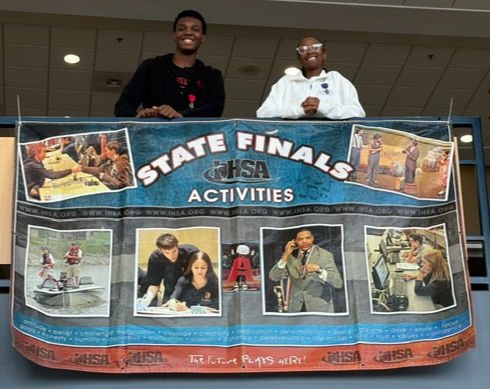
The competition is split into categories, including sports writing, feature writing, news writing, advertising, photography, and TV broadcast. Each category has its own expectations, but they all center on the same idea. Students have to gather information and turn it into a complete, clear product within a strict time limit. Because of that, preparation is a big part of the process. Students spend time before competitions practicing prompts, reviewing AP style, and focusing on areas where they need improvement so they are ready for whatever category they are in.
“When preparing for the competition, I get a bunch of prompts and I kind of just have to write about them, and it helps me focus on areas I need to focus on, and if I get something incorrect, then I can go back and fix it in order to be ready for the competition,” news writing competitor Trinity Humphrey said.
The first stage is sectionals, which are usually done virtually. Students are given a prompt and a time limit, then must complete and submit their work online before the deadline. Some students write full articles based on fake events, others design flyers or advertisements, and photography students may be asked to capture or organize images based on a specific theme. Even though it’s online, the pressure is still real because everything has to be completed correctly within the given time.
“So usually we’re online, so we submit due online. It's just mostly online, and you complete it within the given time,” broadcast teacher Mr. Mays said.
For writing prompts, students are given information like stats, background details, and
sometimes quotes. They have to turn it into a full article in a short amount of time. The main
goal is to include the important details, organize them clearly, and make it seem like a real story, depending on what category you’re writing for.
“It just really depends on what you’re competing for,” Chase Stone said. “Like for sports, they want stats, an instant lead, and a strong overall story that's put together.”
Once sectionals are scored, students who place high enough move on to the state finals. The state is more competitive and in-person, where students go up against schools from across Illinois. Everything has to be correct, from AP style to structure to timing. Even the smallest mistakes can make a difference in the final ranking.
“You have to make sure you hit all the requirements,” said Humphrey. “Like the word count, the quality of writing, and everything they're asking for.”
Different categories test different strengths. Photography students focus on imagery, while advertising students are judged on creativity, design, and how well they follow these instructions under time pressure. As well as writing, students are focused on turning prompts into clear, organized stories.
“It depends on the area, but a lot of it is writing skills, attention to detail, and staying consistent,” journalism teacher Mr. Kenealy said.
Broadcasting journalism shows a different kind of challenge. Competitors have to play the roles of reporters and editors at the same time, filming, interviewing, and editing within a short time frame.
“They give you a prompt, and you have to film, interview, and edit it all together,” Mays said.“Then submit it for judging, and everything has to be organized and clear.”
Students say one of the hardest parts across all categories is the time limit. Students have to think fast and finish work without going over the limit. Extra time is not given, so they have to stay focused and keep moving, regardless of whether things feel stressful.
“The most challenging part is probably staying within the time frame. So for me, I was doing advertising and making flyers,” Nicole Lomax said. “So for me, I can take as much time as I want to do flyers, so when it came to competition time, I tried to get it down in an hour and 30 minutes, which I feel like was the hardest part for me. “
Even if students don’t advance to state, they still gain experience that helps them improve their skills and understand how real journalism works. For many, it’s also about representing their school and being part of something bigger than just an assignment.
“It means a lot,” Humphrey said. “I love representing Crete and showing what we can do.” Overall, the competition gives students a chance to experience real-world media pressure, where deadlines are strict, expectations are high, and everything has to come together in a short amount of time. Regardless of whether they win or not, they still feel proud to represent Crete-Monee in the end.


Comments